|
–Geoff-Hart.com:–Editing, Writing, and Translation —Home —Services —Books —Articles —Resources —Fiction —Contact me —Français |
You are here: Home (fiction) --> Channel Islands --> May 10: Jersey Island
Vous êtes ici : Accueil (fiction) --> Channel Islands --> May 10: Jersey Island
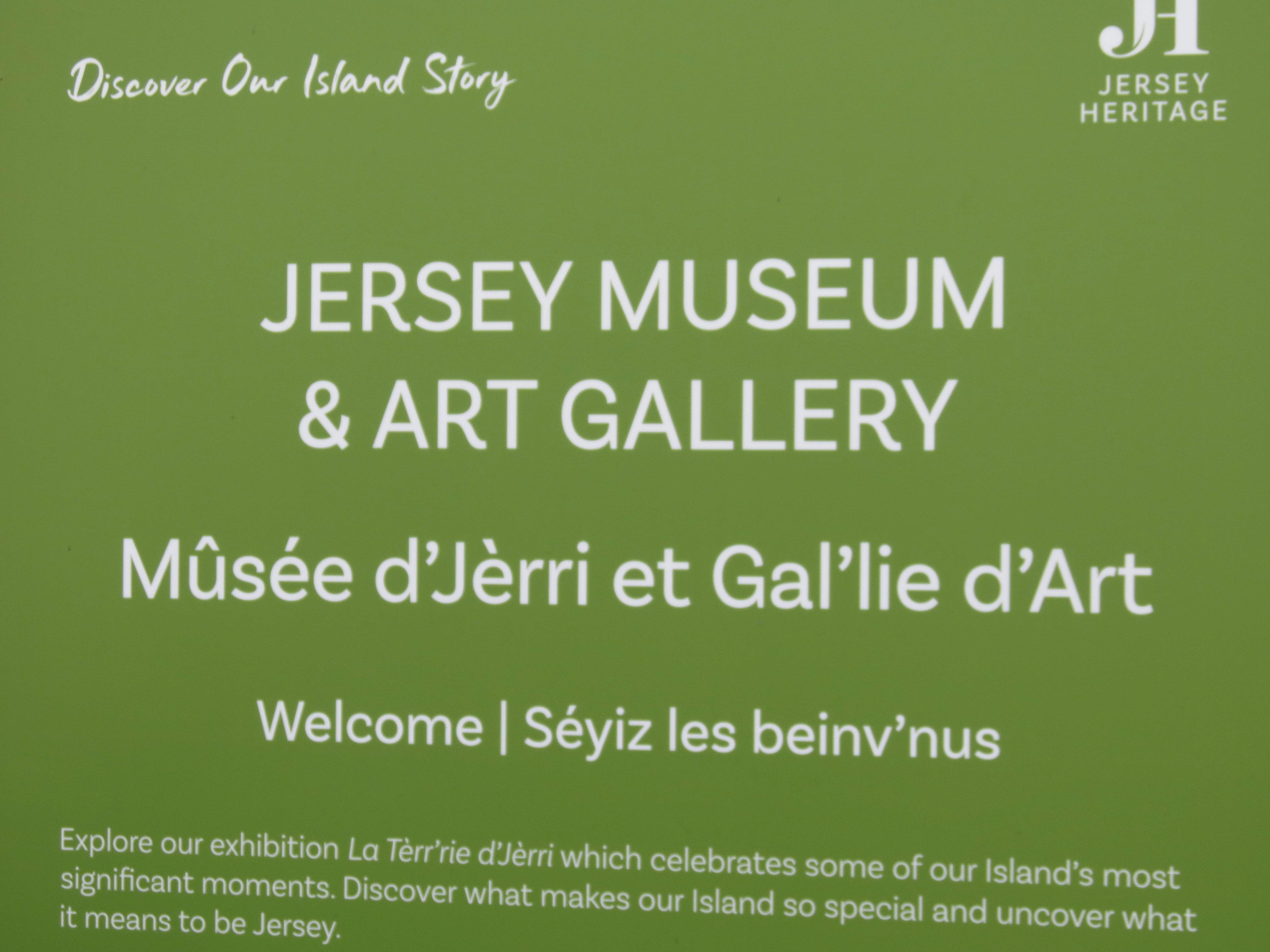
Forgot to add a couple notes about Jersey language in previous blog entries. Although English is spoken everywhere, you'll still hear a lot of French—but also a local dialect of French called Jériaise (pronounced jerry ayze), which is old French heavily flavored with Norse (= the Norman language of the Vikings who conquered northwestern France). Lots of syllables are omitted and replaced with an apostrophe. This can make it difficult to parse if all you know is modern French. For example, here's a sign at the museum we visited yesterday:
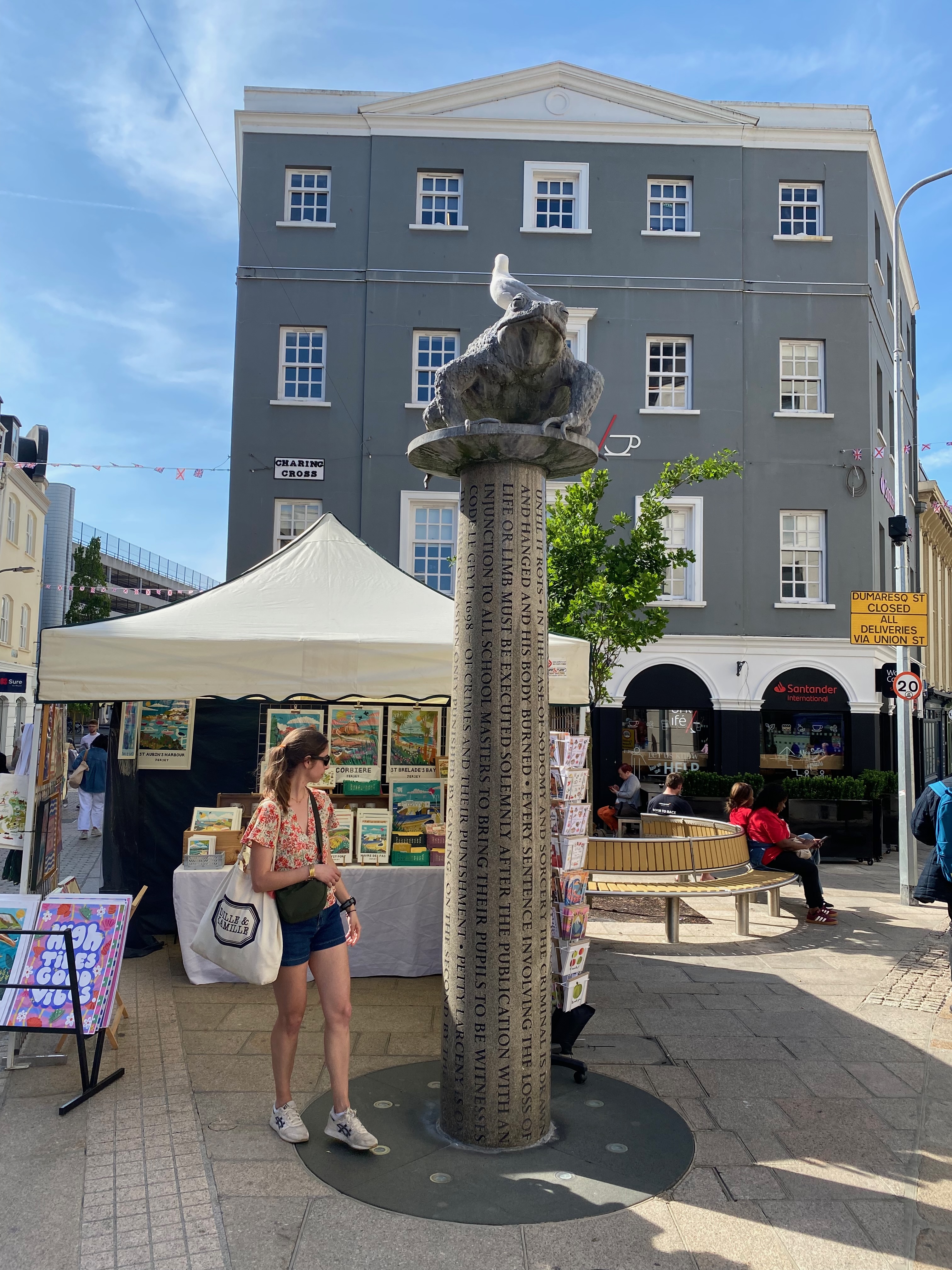
Jersey residents often refer to themselves as "Jersey beans". This is seemingly a mix of human "beans" (beings) and a reference to a popular local bean dish (a form of cassoulet) that may have been the distant ancestor of Boston beans. (Note to self: we need to hunt down that bean dish!) The residents are called "crapauds" (the French word for "toad") by their Guernesy rivals because Jersey has toads and Guernesy doesn't. Instead, they have tortoises, but despite that, the Guernesy folk are nicknamed "donkeys". No idea why. The Guernesy linguistic dialect is Guernésiais. No idea how that relates linguistically to Jériase.
The crapaud is immortalized sitting atop his pillar in the heart of the shopping district, with bonus elegant seagull chapeau (photo contributed by Shoshanna):
Today's breakfast was a really good vegetarian omelette whipped up by our hostess Elena: probably three eggs, with a ton of tomato and spinach. Yummy, but very filling. I think Elena was a mother bird in her previous life, since every time we open our mouth, she fills it with more food. After one of her breakfasts, we've rarely felt the need for lunch, which is not to say we haven't been snacking. Good thing we're doing so much walking!
Today's plan was to visit Shoshanna's friend Trepkos, who would take us around to see a few areas she really enjoyed and felt that we would enjoy, some of which we had already added to our "must see list". We started by taking the bus to her home, which had no street number. Jersey, like many other places that grew without starting out with numbered streets, relies on building names instead of street numbers in many areas. For example, many of the homes around her house were named with some variant of "rock" in mind (e.g., "Rock Ridge"). You can choose the name yourself, so long as you register the new name with the local government and post office.
Trepkos and her partner are both serious science fiction and fantasy fans, so we spent an hour bonding over our shared love of the genre before hitting the road. She took us first to the Saint Catherine breakwater, which sticks out about half a kilometre into the sea at the northeastern tip of Jersey Island. There was a stiff breeze, so the waves were pounding on the breakwater's upwind edge, hard enough that one wave threw spray a good 10 metres into the air to wet us.
From the breakwater, we went to a local nature reserve in the central eastern part of the island. It's nestled in a steep-sided valley with a stream at the bottom, with lush vegetation climbing both slopes. Lots of trees, flowers (mostly pink but much foxglove with purple-pink flowers about an inch long and yellow-glowing buttercups), English ivy climbing many of the trees, and many families out walking their dogs and their kids.
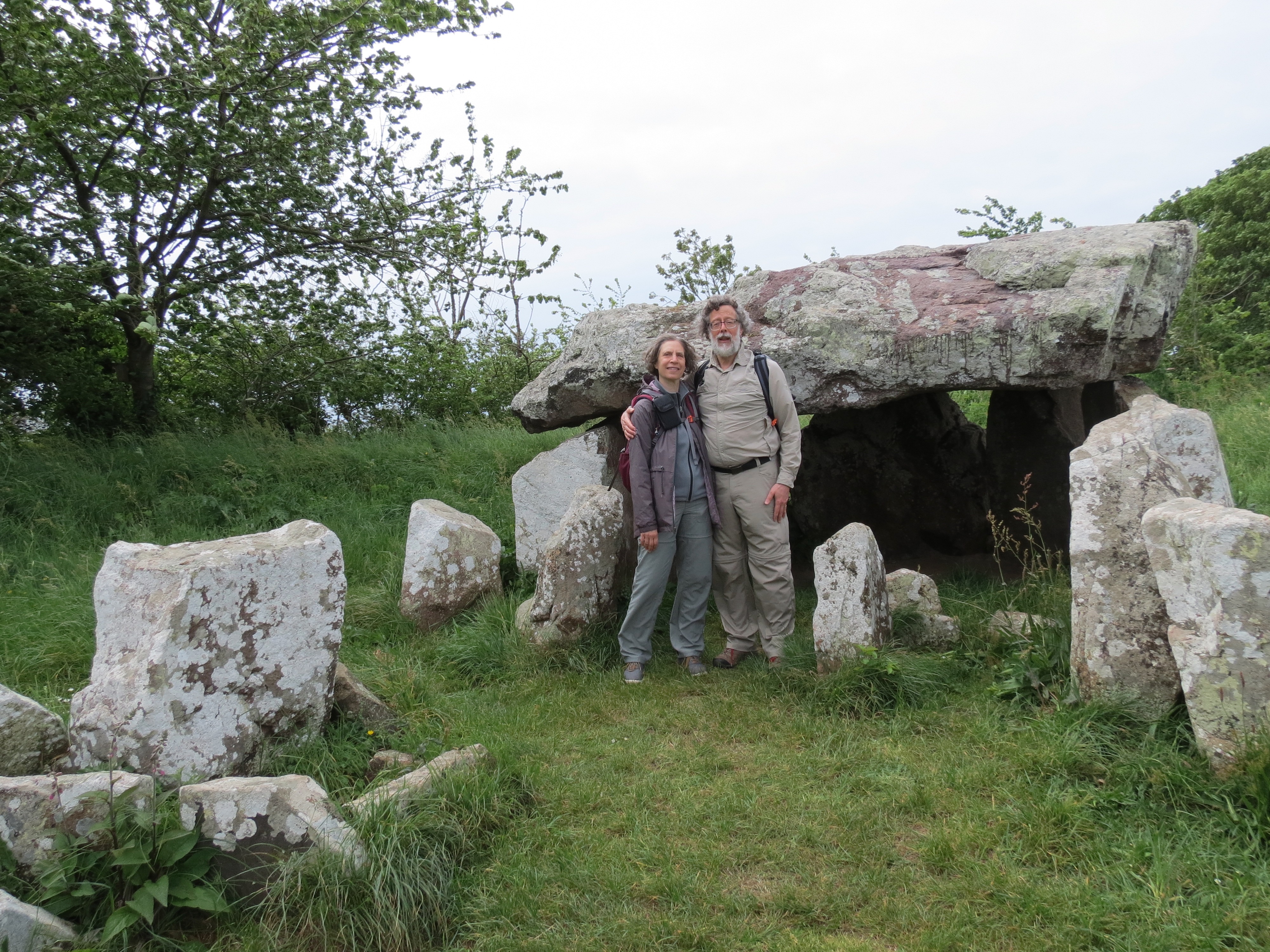
Next stop was the Faldouet dolmen, an old tomb or place of worship built from enormous stones that were hauled there from a nearby quarry and installed in the ground, pointing upward. Topped off with an even large stone that formed the roof:
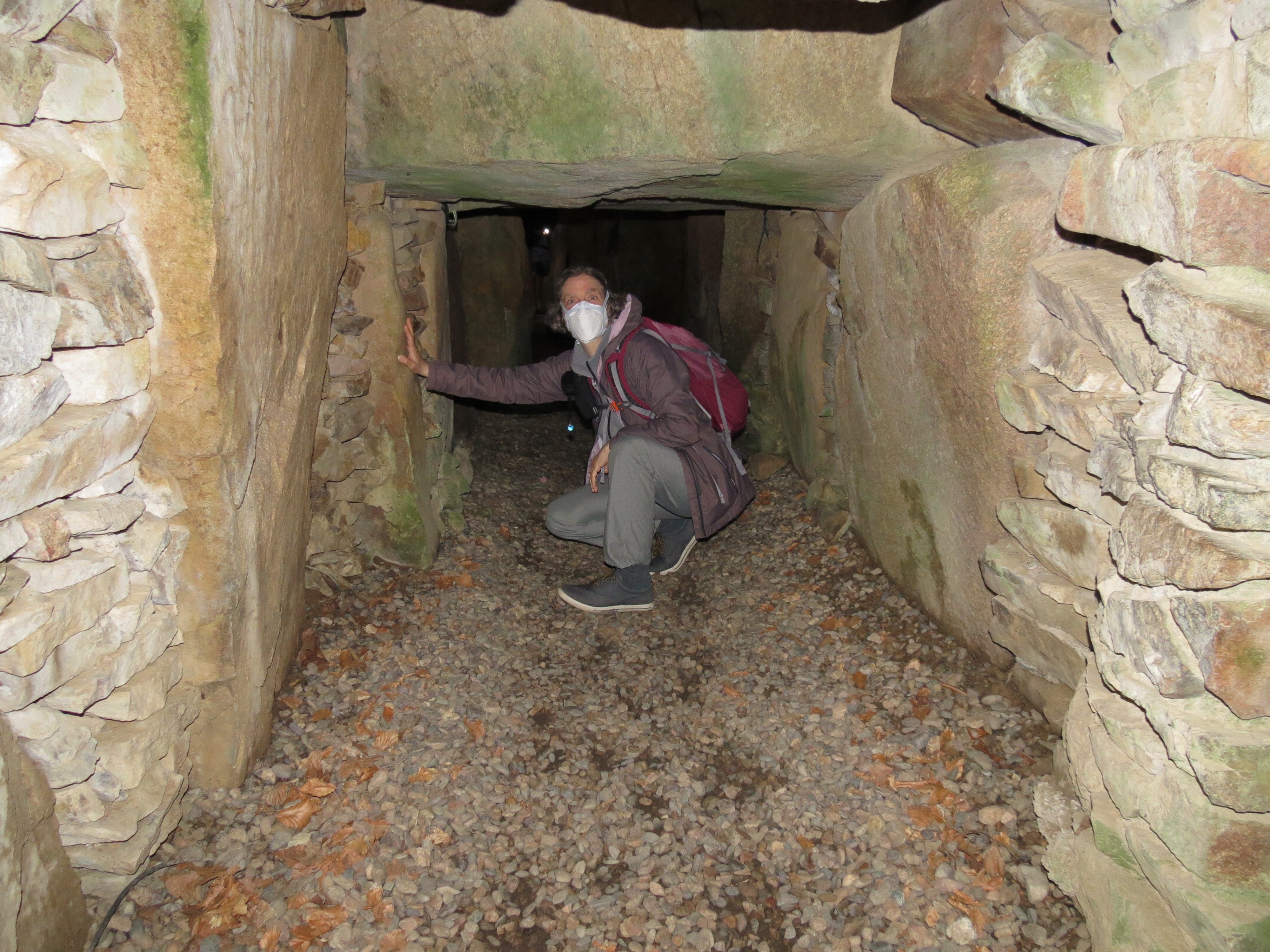
Our last stop was the Hougue Bie center, a museum that had specimens from the largest discovery of Celtic coins and jewelry that date back to the time of the Roman conquest of Gaul and other parts of northwestern Europe, including Jersey. The treasures were buried in a pit and only discovered a few years back by a hobbyist with a metal detector. Nobody's 100% sure about why they were buried there, but my favorite hypothesis was that they were buried there to escape Roman taxation. Much of the jewelry was beautifully done: as intricate and well made as anything modern. In addition, they had a much bigger underground tomb buried underneath a large hill topped by a small cathedral:
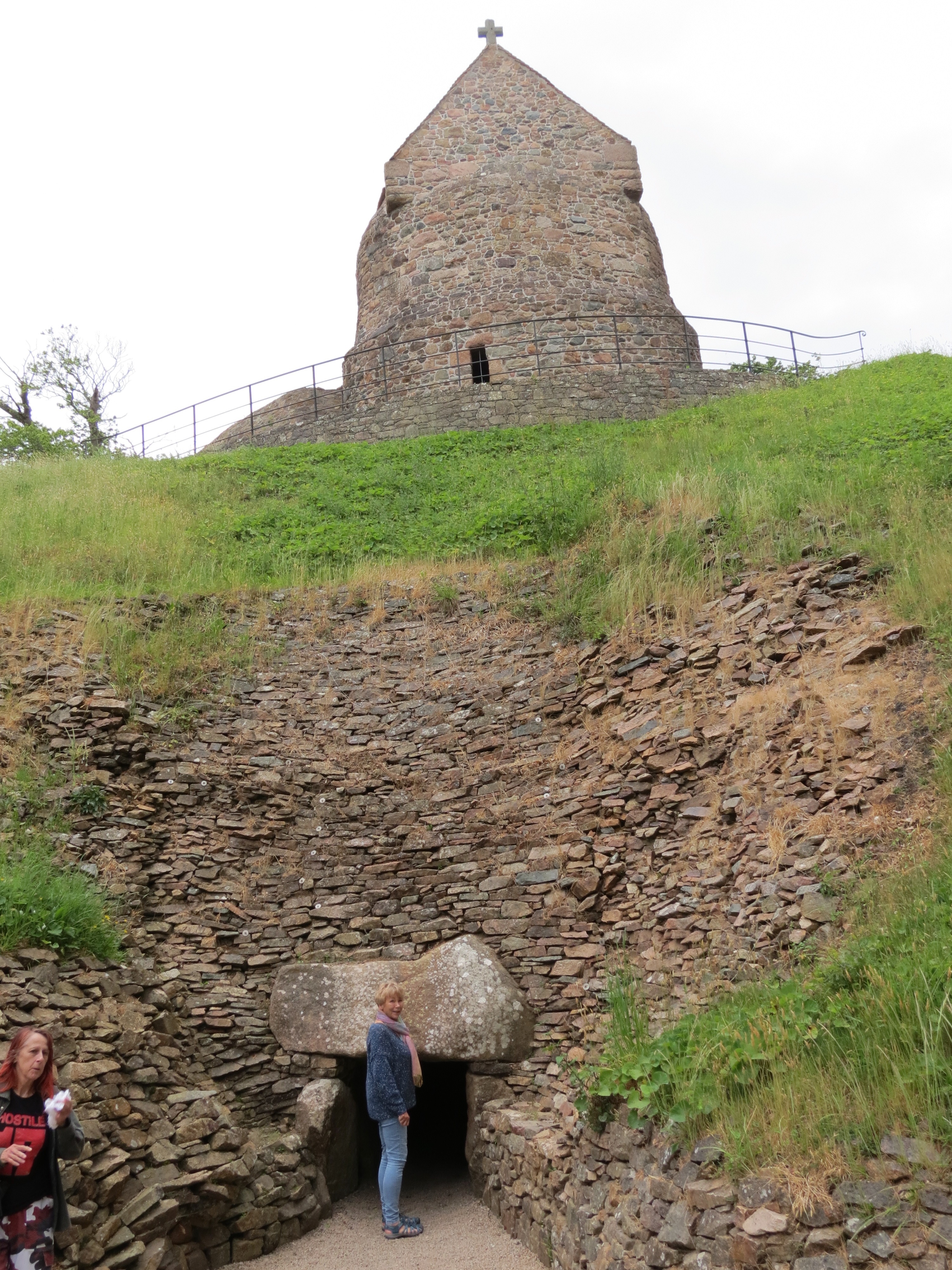
Entry to the tomb required duck-walking with bent thighs to avoid whacking your head on the roof. Shoshanna embraced her inner tomb raider:
The last exhibit of the center was a German bunker that had been converted into a memorial to the slave laborers shipped to Jersey from Russia, Poland, and other places in Europe and basically worked to death—unless they were instead exported back to Germany for extermination. It's amazing any of them survived inadequate food, beatings, tortures, and other forms of abuse while performing backbreaking labor every day except the 2nd Sunday of the month, when they weren't fed because they weren't working. Those who survived told their stories and left them as their legacy for us.
The wind had grown cold, so we went into the center's café to warm up. We had a delicious early dinner: a big bowl of piquant and delicious tomato soup accompanied by a giant toasted bun for dipping. Filling enough that we decided to skip dinner tonight.
Tomorrow's plan is to head up to the northwestern corner of the island, where we'll try to complete a 12-km hike along the shoreline from Gros Nez ("big nose") point and moving eastward to "the Devil's hole", a keyhole eroded in the cliffs. The hike description suggests 4 hours, so we're budgeting up to 6 to allow for aging muscles and the many ascents and descents to get from cliff top to sea level and back again. If we get there by mid-morning, as planned, we should be done by late afternoon and home (i.e., back in St. Helier) in time for diner.
It will be grueling, so we're holding out the option of bailing out midway along to take a bus home. (We'll take a bus home anyway; the only question is when.) One lovely thing about Jersey is how well developed the bus system is; you can get around most of the island fairly efficiently, enough so that it's feasible to break longer hikes into smaller segments and return the next day to start over where you left off. There may be delays in some more remote areas, where the buses may only come every hour or so, but we'll keep an eye on the time to see how our progress relates to the nearest bus stop.
©2004–2026 Geoffrey Hart. All rights reserved.