|
–Geoff-Hart.com:–Editing, Writing, and Translation —Home —Services —Books —Articles —Resources —Fiction —Contact me —Français |
You are here: Home (fiction) --> Channel Islands --> May 19: Guernsey Island
Vous êtes ici : Accueil (fiction) --> Channel Islands --> May 19: Guernsey Island
Breakfast was pancakes, which were as good as the first batch, and a lot of watermelon. Madame had and enjoyed the croque sandwich, plus a croissant for dessert. Again, enough to fortify us for a day of walking without being excessive.
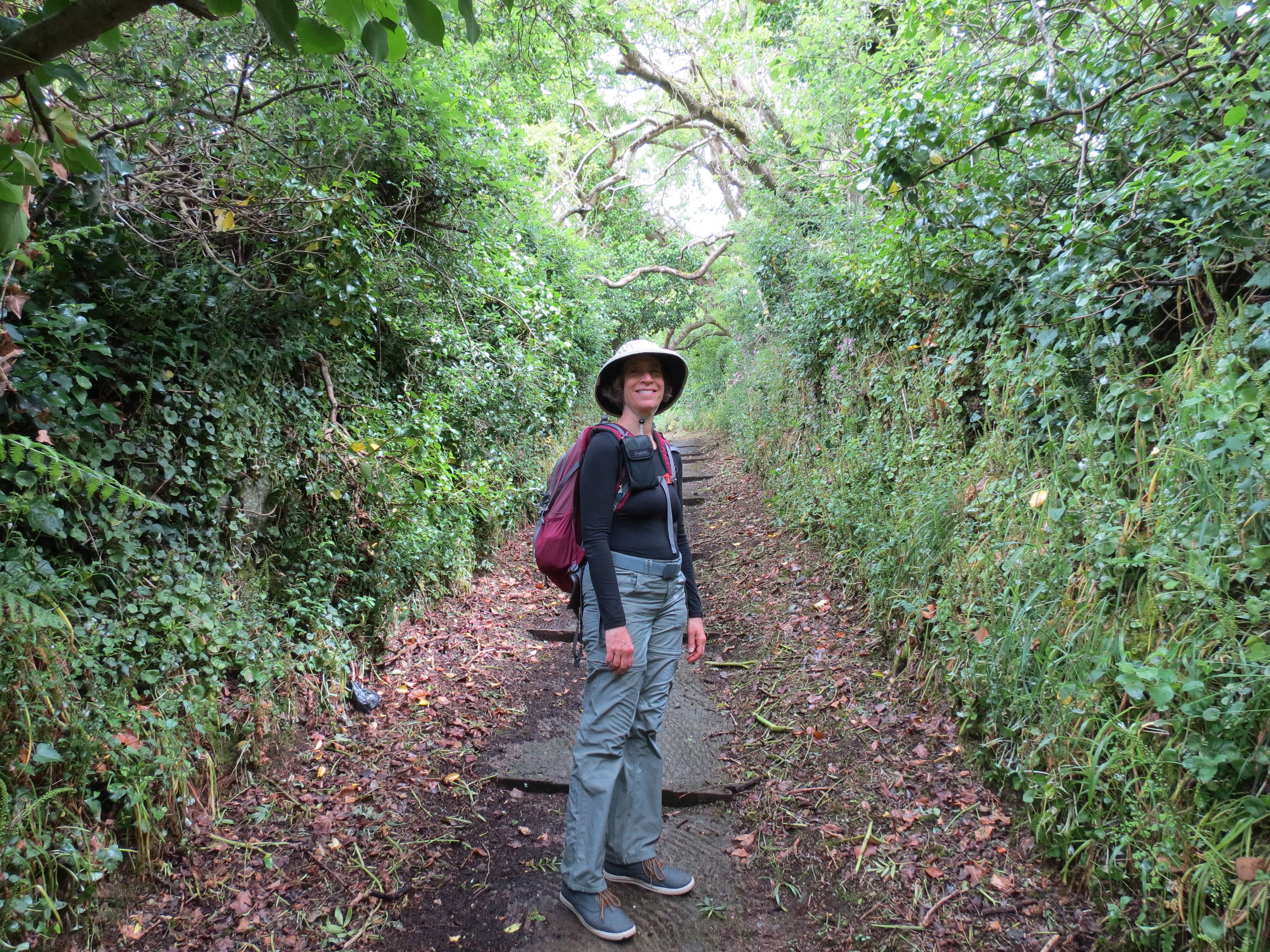
Today's goal was to wander along country lanes (what the Guernese call ruelles tranquilles (quiet roads,with fewer vehicles and slower travel) until we reached the Guernsey Folk and Costume Museum. Took us a little over an hour to get there, pausing to admire the lush patches of forest and grasslands and the long, tree-canopied roads, most of which had sidewalks or sufficiently infrequent traffic that we didn't have to be particularly cautious watching out for incoming vehicles. The weather was pleasantly cool and cloudy, so walking was easy (moreover, NO STAIRS!!!), and we only had a small amount of rain. We saw our first two outdoor cats in about 2 weeks, and tried to lure them closer, but they were having nothing to do with us.
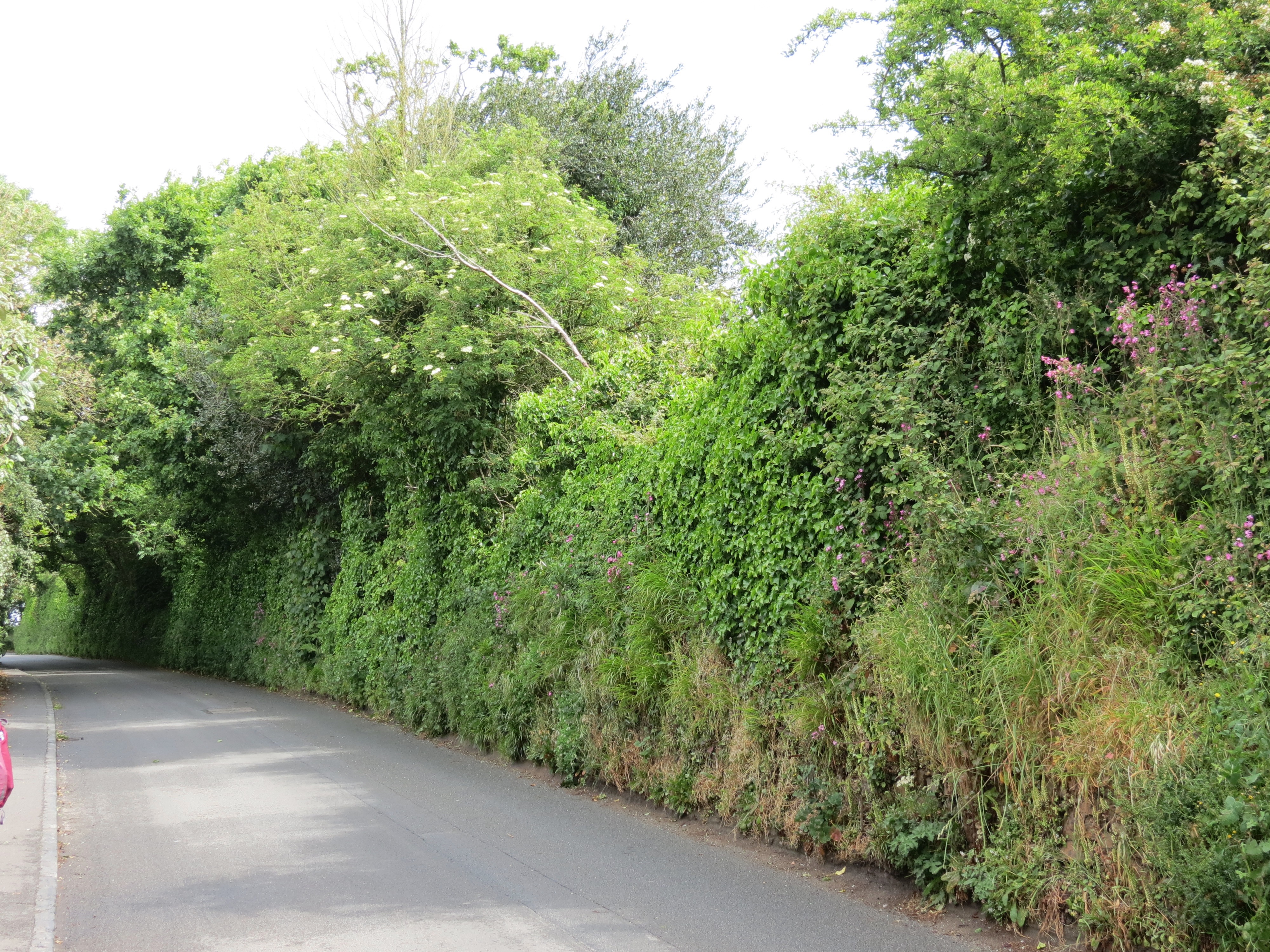
One of the visually fascinating aspects of Channel Island country lanes is that they're often surrounded by walls of green that range from head-height to maybe 4 metres. Without looking close, it's hard to know whether it's vegetation such as vines growing on and concealing a stone wall or a living wall of shrubs and wildflowers stabilizing a bank. The vegetation is so dense that even a close look won't always reveal what's going on beneath the surface. It's generally a beautiful tapestry, and seems quite remarkably diverse from the perspective of plant species. There are also weird things like bamboo growing wild (in most countries outside Asia, it's grown in concrete planters to prevent it from escaping and dominating the landscape) and tropical palm trees (which can grow here because of the surprisingly warm climate). Few bugs of any sort, and not many birds other than the ubiquitous crow pairs.
Tall hedgerow along a ruelle tranquille:
Shoshanna of the hedgerows:
The museum is part of a larger complex of botanical gardens and a Victorian kitchen garden that covered something like half an acre. We started by wandering through the kitchen garden, then stopped at the coffee shop, where we shared a plate of fries. (We didn't want to ruin our appetites for later.) Channel Island potatoes feature the "Jersey Royal" variety, which has a "Protected Designation of Origin" certification, kind of like the the appelation d'origine contrôlée for wines. Not to be deterred in my quest to compare ice cream between Jersey and Guernsey with true scientific rigor, I had a vanilla soft-serve cone for dessert. The jury's still out over which brand is best, but the Guernsey variety's awfully good ice cream.
The problem with all this tempting and delicious food is, as I told Shoshanna, that we'll need to take on an exercise routine when we get home to Kingston to consume all the calories we've accumulated. As the French say, that may be a défi de taille (a "sizeable" challenge).
The shoestring fries were surprisingly good compared with their bland North American equivalent. Royals really do have a different flavor or texture or both compared to the more familiar Canadian spud. They're described as having a nutty flavor and waxy texture (in a good way). Not sure how they differ beyond that, but I have a feeling they'll spoil us for ordinary potatoes once we're home.
The museum itself was small but nicely stocked with intriguing artefacts, grouped as small indoor rooms for living spaces (e.g., mock-ups of a kitchen, a bedroom, a child's room), special collections (e.g., women's dresses from the past century), workshops (e.g., for carpenters, coopers, and tinsmiths), and out-of-house rooms (e.g., a cart house that stored horsedrawn carriages, a barn full of agricultural implements such as giant plows). Lots of interesting stuff, all well preserved.
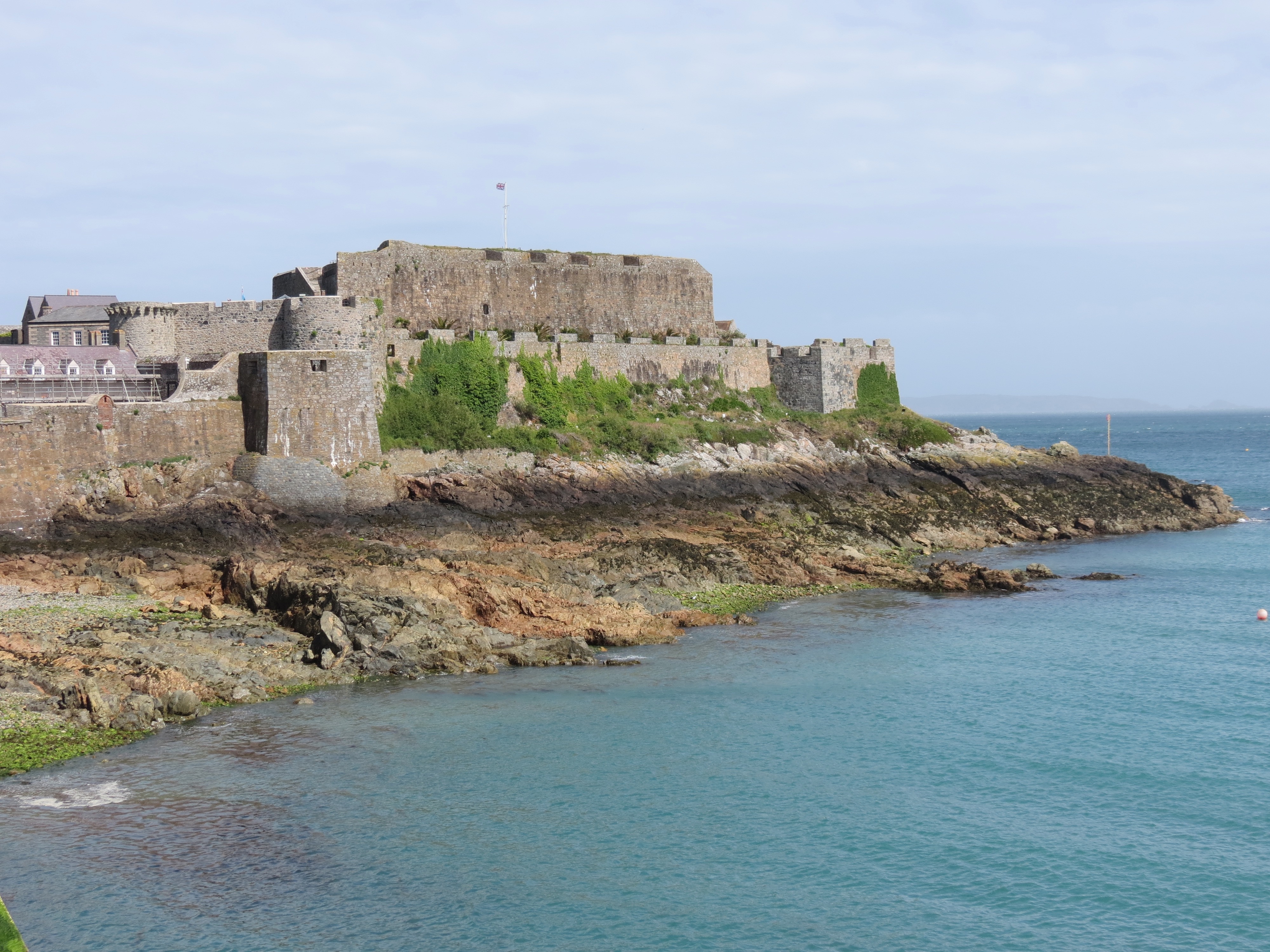
As we prepared to set about our next walk, it began looking like it was going to rain fairly heavily (for about an hour based on a quick glance at the weather radar), so we chickened out and took the bus into St. Peter Port instead of walking an hour-plus in the rain. Needless to say, almost as soon as we got on the bus, the rain blew off in another direction, replaced by sunny skies and warm, but very windy, weather. We wandered out to Castle Coronet, a sprawling and massive complex that has guarded St. Peter Port's harbor for some 800 years in one form or another. Shoshanna and I agreed that it wasn't, strictly speaking, a castle, but disagreed about why we felt the nomenclature was wrong; she felt that a "castle" should be a dwelling and not just a barracks, in addition to any defensive role, whereas I felt that a castle should really be a single building and should be renamed a fort when it began to metastasize into multiple buildings and defensive zones. I suppose the "true" definition lies in how you're defining the context.
Fort Coronet:
Earlier in the day, we decided that our island day trip would be to Sark, so we reserved tickets for Friday. Given we were in the port area, we took the opportunity to locate the ferry dock from which we'll leave. Found it with no problem. Our hostess at the B&B explained something we'd wondered about: why the ferry schedules were so odd. The answer, obvious in hindsight, is that they're strongly affected by tides: you can't drive a ferry over a reef or stretch of sand at low tide.
Earlier, I spoke about the amazing skill of the bus drivers, who rocket down the narrow roads, outer mirror often literally brushing aside vegetation from hedgerows or missing stone walls by inches. Apparently I spoke to soon. Drivers over the past several days have been hitting curbs with surprising frequency, causing the whole bus to shudder and probably dramatically shortening the tire's lifespan. They also tend to borrow the sidewalk, where one exists, as a temporary third lane if they don't want to slow down to see whether they and another vehicle can both fit into the same narrow space. Not scary, since despite their liberal interpretation of the concept of lanes, they seem very careful about pedestrians, bikers (though they often crawl up seemingly right next to the bike's rear bumper), and other vehicles. We haven't seen any collisions or their residue, though we have occasionally seen shattered side mirrors lying by the side of the road.
For dinner, we went wandering through St. Peter Port to see if any restaurants were open and (ideally) had outdoor seating. No luck, since few places were open; most were closed for the 3 PM to 6 PM siesta, when cooks and waiters have time to recover from the previous onslaught of famished tourists. We're saving the Deerhound for another night while we wait for previous meals to finish digesting, and wanted to try some alternatives. As it was getting late, we decided to solve the food supply problem by dropping in at the local Marks and Spencer store. In case you're not familiar with them, M&S is a London-based chain that has been around for nearly 150 years as a semi-high-end department store. More relevant to the present challenge of feeding ourselves, they have a great food section that features both prepared meals and fresh ingredients. We got two really nice wraps (a nicely creamy chicken Caesar, a sweet and lean hoysin duck) to share. Shoshanna also got a tuna salad with corn kernels, and I got a package of sweet chili crisps (= potato chips). She got a bottle of "hazy" cider, which is cloudy because it hasn't been filtered. She liked it less than the Thatcher hazy cider she tried a couple days ago, but enjoyed it enough to finish a pint bottle. I got a pint bottle of "best bitter" beer by Adnams Brewing (yes, that's how it's spelt) from Suffolk, which was quite good. This is a beer genre that tends towards the hoppy side, but in my opinion, is much more palatable; it rarely has an overpowering hoppiness (e.g., a grapefruit taste) or excessive floral notes.
Tomorrow we're going for another off-road hike. Not sure whether we'll choose the northeast or southeast coast. Stay tuned!
©2004–2026 Geoffrey Hart. All rights reserved.